
Does College Still Matter? A President’s Perspective
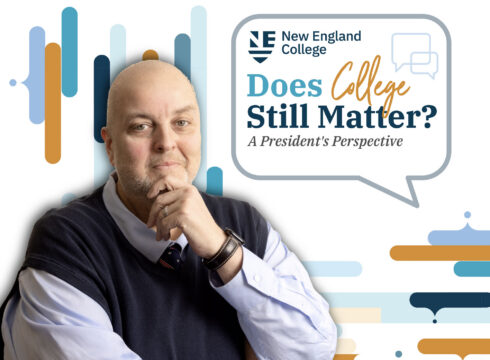


This article appeared in the spring 2026 issue of New England College Magazine.
By Dr. Wayne F. Lesperance, Jr., President of New England College
It’s a fair question and an increasingly common one: Does college still matter?
In a time defined by rising costs, alternative credentials, and rapid technological change, skepticism about higher education is not only understandable but also necessary.
But after spending my career in this field, my answer is clear: College does matter. Perhaps now more than ever. The challenge before us is not to defend higher education reflexively, but to articulate its value honestly and to evolve in ways that meet the moment. At its core, a college education is not simply about earning a degree. It is about becoming an educated person. That means being exposed to new ideas, different cultures, and competing perspectives. It means
developing the ability to think critically, communicate effectively, and continue learning long after graduation. Those habits are not luxuries; they are essential for navigating a world that is changing faster than any generation before us has experienced.
When I graduated with my undergraduate degree in 1991, there was no internet, no social media, no smartphones or tablets, no artificial intelligence shaping daily life. Everything I’ve needed to learn since then has required adaptability, and the tools to help me be adaptable were provided to me through the college education I received. That is what college, at its best, provides: not just preparation for a first job, but preparation for a lifetime of change.
There is also something uniquely powerful about the college environment itself. For a brief period, typically four years, students are immersed in a setting dedicated entirely to growth. They live, learn, and engage in a community designed to challenge and support them. It is one of the few times in life when individuals can fully devote themselves to intellectual and personal development, guided by faculty who have committed their lives to teaching and scholarship.
That experience is difficult to replicate elsewhere. Workplaces demand productivity. Life brings competing responsibilities. But college offers space: space to reflect, to question, to discover who you are and who you want to become. So, when some would have the college experience reduced to some sort of simple transaction where one attends college in exchange for a degree…well, that misses what’s most important about the experience: the process of transformation that accompanies becoming an educated individual.
Of course, we cannot ignore the most persistent concern: cost.
College is expensive. That criticism is valid, and those of us in higher education must take it seriously. Every dollar we charge must be justified. We are stewards of our students’ and families’ investment, and we have an obligation to ensure that investment delivers meaningful returns.
From a purely economic standpoint, the data is compelling. Over a lifetime, college graduates earn, on average, significantly more than those without a degree, often by a margin approaching $2 million. But the return on investment extends well beyond salary. College graduates tend to live longer, enjoy better health, engage more actively in their communities, and face lower rates of unemployment and incarceration. These outcomes matter, not just for individuals but for society as a whole.
Still, we must acknowledge where higher education has fallen short. As an industry, we have not always done a good job of making our case. We have been too slow to listen to concerns, too hesitant to adapt, and at times too confident that the value of college speaks for itself. It doesn’t. Not anymore.
We must do better.
That begins with aligning education more closely with career outcomes. A college degree should open doors, not just intellectually but also professionally. At New England College, we are working intentionally to bridge the gap between classroom learning and the workforce.
That includes building partnerships with employers, creating opportunities for students to “earn while they learn,” and ensuring that academic programs are informed by real-world needs.
Imagine a graduate crossing the stage with a diploma in one hand and a job offer in the other. That is not an aspiration. It is an expectation we should be striving to meet.
At the same time, we must resist the temptation to reduce education to a purely transactional experience. College is not just a pathway to a paycheck. It is a transformative process that shapes how individuals think, engage, and contribute to the world. Employers consistently tell us they value graduates who can write clearly, think critically, and adapt quickly, skills that are foundational to a liberal arts education.
As new technologies like artificial intelligence reshape industries, this balance becomes even more important. AI is a powerful tool, but it raises important questions. If technology begins to replace thinking rather than enhance it, we risk undermining the very purpose of education. Our responsibility is to integrate these tools thoughtfully and use them to amplify human capability,
rather than diminish it.
Higher education must also expand its reach. Today’s students are not only 18-year-olds living on campus. They are working professionals, parents, and individuals seeking advancement or career change. Meeting students where they are—through flexible, online, and career-focused programs—is essential to remaining relevant and fulfilling our mission.
Ultimately, the question is not whether college matters. It is whether we are willing to do the work required to ensure that it continues to matter.
For me, this work is deeply personal. My own college experience shaped the trajectory of my life. It instilled in me a commitment to learning and a desire to serve others, values that continue to guide me today. I often reflect on how different my experience might have been in a smaller, more connected environment like the one we strive to create at New England College, where students are known, supported, and challenged as individuals.
That sense of community is not incidental; it is central to the value of higher education. When students feel seen and supported, they thrive. And when they thrive, the impact extends far beyond the classroom.
So, does college still matter?
Yes, but only if we are willing to listen, adapt, and lead with purpose. Only if we hold ourselves accountable for delivering both intellectual growth and tangible outcomes. And only if we remain committed to the idea that education is not just about making a living, but about making a life.
That is the case we must make and the promise we must keep.
Learn More
Apply to NEC
Explore Academic Degree Programs
Read More NEC News