
Leading with Purpose: NEC’s Principal Licensure Program Is Preparing New Hampshire’s Next Generation of School Leaders


Every educator can point to a moment when they realized they wanted to make a greater impact.
For Morgan Winchell, that moment came from looking beyond the walls of her own classroom. As the sole physical education teacher at New Boston Central School, she often found herself working in isolation. She began to wonder what it would be like to bridge the gap between classroom teachers and school leadership and whether she could become the kind of leader who helps schools work better together.
For Sadie Geary, a special education teacher at Thornton’s Ferry School in Merrimack with a decade of experience, the motivation was different but equally personal. She wanted to ensure every child, especially those whose needs are often overlooked, has a school where they feel safe, supported, and understood.
Their paths converged in New England College’s School Principal Licensure Program, developed in partnership with the New Hampshire Association of School Principals (NHASP). Designed specifically for working educators, the program combines rigorous academic preparation with real-world leadership experience, creating a pathway for teachers ready to shape the future of New Hampshire schools.
Learning from Leaders Who Are Living the Work
One of the program’s defining strengths is its faculty. Rather than learning solely from career academics, students are taught by practicing principals and school leaders who bring today’s challenges directly into the classroom.
“I found out that real, live principals are teaching the courses,” Geary said. “They’re not instructors who are far removed from today’s academic challenges. They’re invested in real time, and I thought that was cool.”
That immediacy has made the coursework especially meaningful.
“I feel like there’s a lot of real-world application they can offer that maybe wouldn’t be available in other programs,” she said.
Paul Dutton—principal of North Elementary School in Londonderry and instructor of Learning and Leadership at the District Level, the program’s opening course—believes that connection between theory and practice is intentional.
“I think it’s really tangible,” Dutton said. “All the work is meaningful and authentic to what they’re doing. It’s been precise and focused by design to make sure they’re getting what they need.”
Dr. Deanna Donnelly, Assistant Principal of Lincoln Street School in Exeter, teaches School Operations and Management in the program and echoes that philosophy.
“This course is very rigorous,” she said. “It’s very hands-on and very concrete. Students communicate with facilities directors and principals. They study school safety, scheduling, teacher evaluations, everything we deal with in schools on a daily basis.”
A Program Built for Working Educators
Every student in the cohort is balancing coursework with a full-time career. That reality shaped how the program was designed.
“The expectations are not unreasonable,” Geary said. “I’ve never had to decide whether I should focus on my work or my homework. It’s never been a battle between the two. It’s been a really good balance.”
Faculty members understand the realities of life as educators because they’re living those realities themselves.
“They’re wonderful,” Geary said. “You can text them, email them, schedule a Zoom or a phone call. They’re very approachable and understand that you’re a working educator with a life outside your job.”
Winchell has had a similar experience.
“They’re all available all the time,” she said. “We can text them. We can email them. It’s reassuring to know they’re there whenever you need them.”
Dutton says finding that balance was a priority from the beginning.
“I’ve been really impressed,” he said. “Students are balancing professional responsibilities while completing intensive seven-week courses, but the academic rigor is strong without being so overwhelming that they can’t manage the other responsibilities in their lives.”
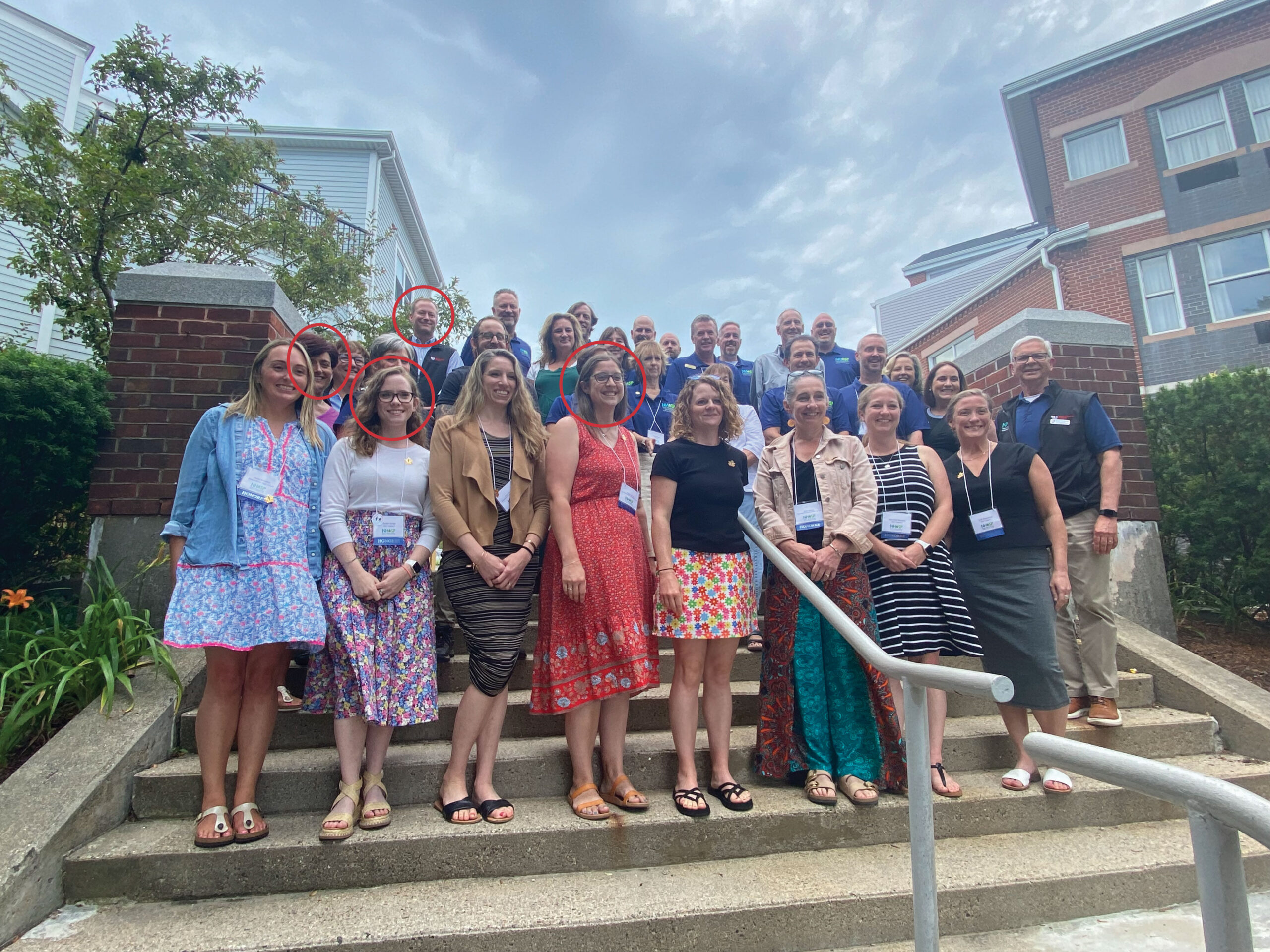
Members of NHASP, staff from New England College, and educators from around New Hampshire gathered for NHASP’s 2026 Leadership Academy in Portsmouth, N.H., June 24–26. Front row from left: Sadie Geary and Morgan Winchell. Second row from left: Dr. Deanna Donnelly. Back row from left: Paul Dutton.
Building Leaders Through Community
While the coursework is important, students say one of the most valuable parts of the program has been the community they’re building with one another. Winchell says discussions with classmates from districts across New Hampshire have already broadened her perspective.
“Our discussion posts and seeing what their jobs are and what they do has been really helpful,” she said. “Their schools are so different from mine. I can’t believe some of the things they’re going through because it’s nothing like my little town.”
Those relationships are intentional. Anna Parrill, Mentor Coordinator at NHASP, reminds students that earning licensure also means joining a statewide network of educational leaders.
“That’s why this program is different than anything else that’s out there,” Parrill said. “All of us are here to support you on this journey. We want you to be successful.”
Dutton believes those relationships become invaluable once graduates step into leadership roles.
“The cohort model allows you to have that tribe, that support network,” he said. “As an administrator, having that community is incredibly important.”
Preparing for Leadership Before the Title
Although the program is still in its early stages for its inaugural cohort, students say they already see themselves growing as leaders. For Winchell, that has meant intentionally stepping outside the “PE bubble.”
“My big goal is to find a bridge between administration and classroom teachers,” she said. “Sometimes we become isolated in our roles, and we need perspective on what each other does in order to work collaboratively.”
The program has already encouraged her to seek out those perspectives within her own school.
“I’ve tried really hard to talk with my assistant principals more and understand what they do,” she said. “Just having those different perspectives has been exciting.”
Geary says the coursework has strengthened skills she knows every future principal will need.
One module on navigating difficult conversations left a lasting impression.
“I don’t like conflict,” she admitted with a laugh. “But through the work we’ve done, I feel like I now have an outline or a script to follow. I feel way more prepared to have those conversations than I did even a year ago.”
Leadership That Starts with Students
Although both students envision becoming school administrators, neither talks about titles or career advancement. They talk about children.
“I just want school to be a place where all kids want to be,” Geary said. “Even if they have academic struggles, I want them to find trusted adults and feel comfortable there.”
Her experience working with students who have emotional and behavioral challenges has shaped the kind of leader she hopes to become.
“I joined special education to have a strong impact on kids who need it the most,” she said. “As a leader, my role will be to impact staff so they can impact kids.”
Winchell shares a similar philosophy. When asked how the program has changed her, she didn’t point to a new credential or technical skill.
“I feel like I’ve gained a little more confidence,” she said. “This is new and terrifying, but I’m excited. I’m intrigued. I want to do more.”
For educators considering the next step in their careers, both students offer similar advice: Don’t wait until you feel completely ready.
“I don’t know that I’ll ever be fully ready,” Geary said. “Why not give it a chance?”
Winchell agrees. “I feel better prepared to take on new challenges,” she said. “I’ve gained confidence, and I’m excited about what’s next.”
Together, their stories capture what New England College and the New Hampshire Association of School Principals set out to create: a program that develops capable school leaders not simply by teaching educational leadership, but by surrounding aspiring principals with the mentors, peers, and practicing professionals who help them become the leaders New Hampshire’s schools need.
The next cohort of New England College’s New Hampshire Principal Licensure program begins Monday, August 24. Learn more and apply today.
###
Learn More
Apply to NEC
Explore Academic Degree Programs
Read More NEC News